Verified Public Summary
The Story in One Sentence
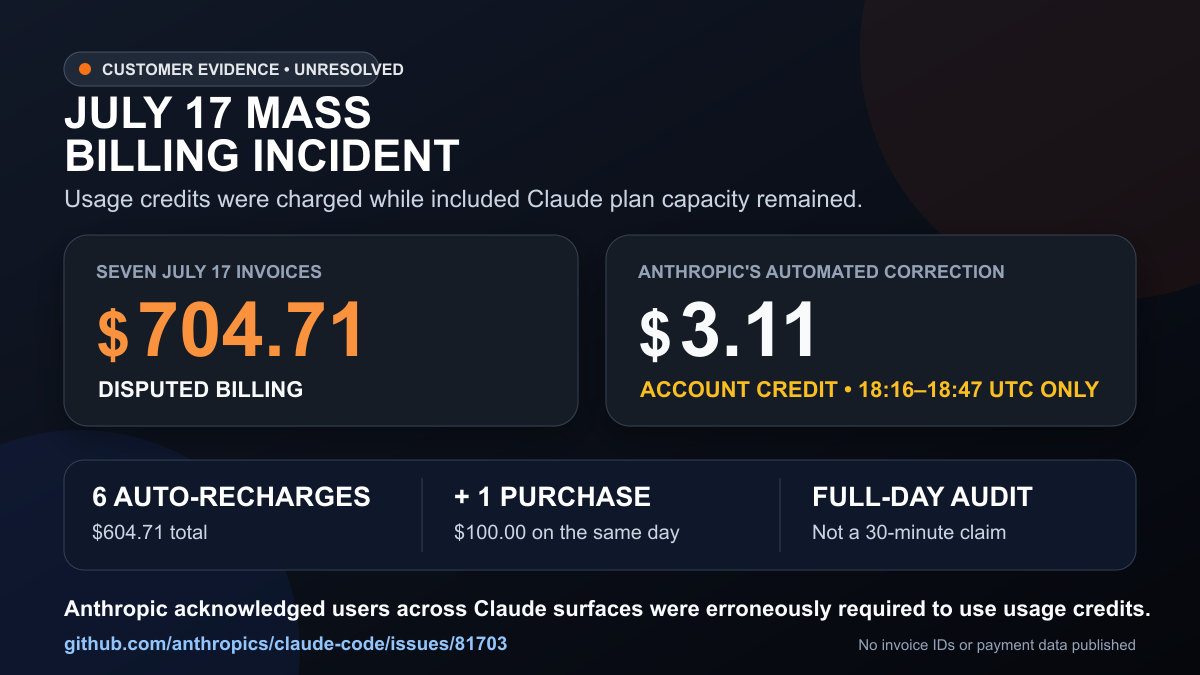
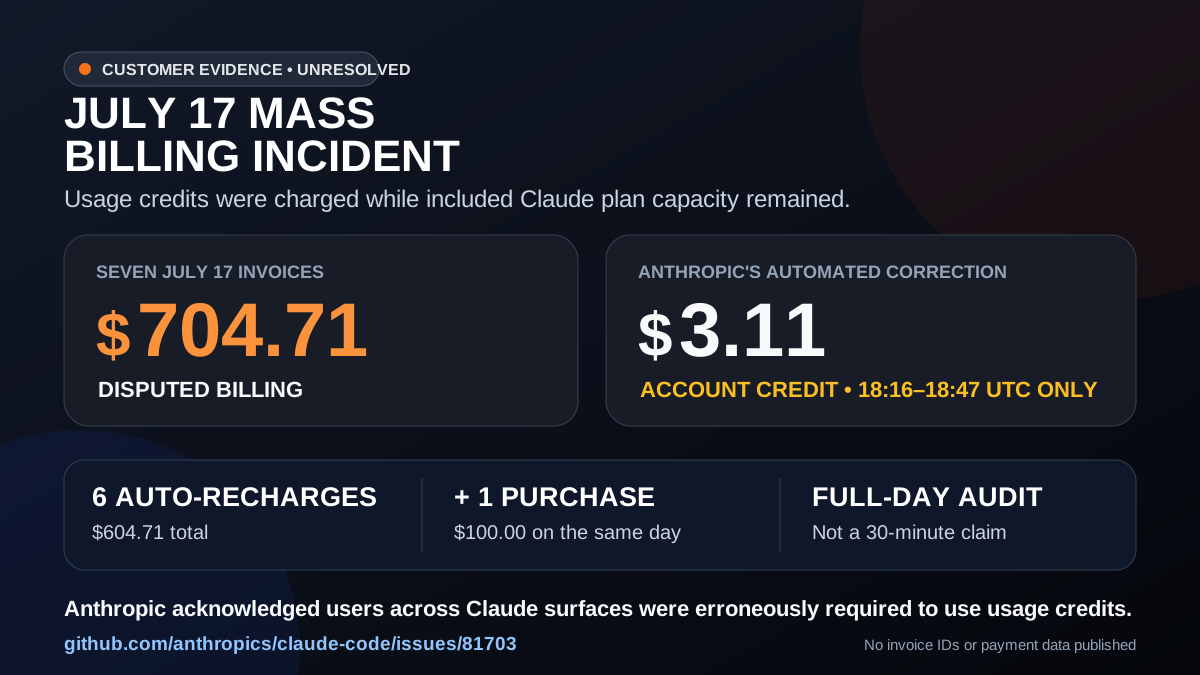
Anthropic acknowledged that users across Claude surfaces were erroneously required to use usage credits for an included model on July 17, but one affected customer's six automatic-recharge invoices total $604.71 while Anthropic's automated correction was only a $3.11 account credit for a self-selected 30-minute window. A separate $100.00 manual purchase is excluded.
The $3.11 expiring account credit is not a refund to an original payment method. The original-payment refund total remains USD 0.00.
The disputed objects are Claude Individual-plan extra-usage credits associated with the subscription account—not Console or API-workspace invoices.
Why This Is Newsworthy
- Anthropic separately documented a July 20 incident in which some Claude Code Max-plan users were incorrectly prompted to use usage credits for plan-included Fable 5. This is first-party recurrence context, not proof of this account, a paid-credit debit, an automatic recharge, common causation, or a refund.
- Contemporaneous users reported unexpected card notifications and claimed $6.32, $50, $100, $200, $287, and $500 usage-credit impacts.
- Every receipt body says Paid July 17, while Gmail delivery timestamps span 18h 47m 50s. The excluded $100 manual-purchase receipt arrived before Anthropic's 18:16–18:47 UTC window, one disputed automatic-recharge receipt arrived during it, and five disputed automatic-recharge receipts totaling $507.59 arrived after it. Email delivery time is not the internal debit timestamp, so this supports a full ledger audit rather than proving causation by itself.
- A privacy-redacted local request-metadata audit contains 2,177 deduplicated July 17 records: 1,241 before Anthropic's interval, 29 inside it, and 907 after it. That places 2,148 records (98.67%) and 97.74% of the four recorded usage counters outside. It proves day-spanning local activity, not billable dollars or request-to-charge causation.
- The customer never claimed a 30-minute scope; the reconciled dispute covers all six automatic recharges dated July 17 across the entire day, with the manual purchase excluded.
- A July 7–18 reconstruction also located $1,006.62 in successful July 7–16 charges and $191.73 in successful July 18 charges. The affected period may potentially extend to those earlier dates and July 18, but that has not yet been established. Those adjacent-period charges remain under investigation and outside the current $604.71 demand unless transaction-level evidence connects them to the same incident.
- Anthropic's current BBB page contains a separate June 29 Billing Issues complaint alleging the same observable mechanism: paid credits consumed while plan allowance remained, with a configured spending limit also allegedly exceeded. It is independent corroboration, not proof of this customer's amount or root cause.
- Metronome's February 2025 company announcement publicly names Anthropic among companies relying on its billing platform. Its correction guidance describes full-state repair across usage, invoices, credit ledgers, reporting, dashboards, and threshold logic. This does not prove which Claude billing layer Metronome handles or who caused this incident.
- Six July 17 auto-recharge receipts totaling $604.71 say
Payment method Link. A later human review under the correct Gmail-authenticated Link account located all six transactions and supplied their card-network/last-four and timestamp/status mappings privately. This proves traceability of the wallet debits, not Anthropic's entitlement/routing decision, recharge trigger, incident causation, or refund entitlement. - A different GitHub participant reported EUR 2,932.51 in charges from July 23–24 and no promised human reply. That later-date claim is unverified, excluded from the customer's $604.71 ledger, and may be a distinct incident.
- A newly opened Anthropic tracker issue alleges 35 unexpected usage-credit charges totaling EUR 1,809.55, including repeated overnight charges about 4–6 minutes apart while Claude reportedly also showed weekly-limit blocks. The issue does not state the charge dates; it is unverified, excluded from the customer's $604.71 ledger, and may be unrelated.
- The support case still shows no visible human billing owner, full-day ledger audit, or complete refund.
The Central Contradiction
Anthropic's own usage-credit documentation says paid credits let subscribers continue after reaching their included plan limits and says the Usage dashboard clearly distinguishes included plan usage from paid credit consumption. Here, disabling extra usage and auto-reload did not stop the work: included plan usage continued. That behavior supports a transaction-level audit of whether July 17 work was incorrectly routed to paid credits while included entitlement remained.
Receipt-Delivery Timeline
The seven receipt emails total $704.71 in the gross chronology, every body says Paid July 17, 2026, and mailbox delivery timestamps span from July 17 09:59:43 UTC to July 18 04:47:33 UTC—18h 47m 50s. The current $604.71 refund demand covers only the six automatic recharges; the $100.00 manual purchase is excluded. One automatic-recharge receipt for $97.12 arrived inside Anthropic's 18:16–18:47 window, while five automatic-recharge receipts totaling $507.59 arrived after it.
Open the public-safe visual timeline →
Email delivery time is not necessarily Anthropic's internal debit, recharge-trigger, payment, or invoice timestamp. The timeline therefore supports a full transaction audit without claiming that outside-window delivery proves causation by itself.
Request-Metadata Window Audit
A privacy-redacted local Claude Code inventory contains 2,177 deduplicated July 17 records spanning 00:00:06–23:46:50 UTC. Using [18:16, 18:47) because Anthropic says included limits worked as intended since 18:47, the records divide into 1,241 before, 29 inside, and 907 after.
That places 2,148 records (98.67%) and 706,168,401 / 722,463,837 recorded counters (97.74%) outside Anthropic's selected interval.
Open the privacy-safe aggregate audit →
This proves day-spanning local activity, not provider-billed dollars, historical plan entitlement, included-versus-paid routing, credit debits, auto-reload triggers, or request-to-invoice mapping. Only Anthropic's authoritative historical ledgers can decide those questions.
Payment-Processor Trace — Transactions Located, Root Cause Unresolved
All six July 17 automatic-recharge receipts, totaling $604.71, say Payment method Link. A subsequent human Link review under the correct Gmail-authenticated account located all six transactions and supplied their card-network/last-four and timestamp/status mappings privately. The earlier no-match result came from a different Link identity and is superseded. Private case, identity, invoice, card, and transcript details remain omitted.
This proves that the six wallet debits exist and can be traced to the correct account. It does not prove Anthropic's subscription entitlement, included-plan-versus-paid-credit routing, paid-credit debit, recharge trigger, or incident causation. Link stated that the PaymentIntent and charge identifiers remain merchant-side details that Anthropic must retrieve. Read the corrected privacy-sanitized processor trace.
Related Later/Unknown-Date Reports — Separate and Unverified
A different GitHub participant reported EUR 2,932.51 in charges from July 23 until a credit-card limit was reached on July 24 and said a promised human support reply never arrived.
This is an unverified third-party claim from July 23–24, not part of the July 17 source set or the customer's $604.71 ledger. It does not prove the same mechanism or root cause and may represent a distinct later incident. Read the participant's public comment.
Another public comment reports three completed July 23 Individual-plan automatic recharges of USD 236.00, USD 205.93, and USD 207.23—USD 649.16 total—and generic support replies. Its attached screenshots visibly show those paid totals and the Auto recharge extra usage, Individual plan item. The reporter's no-interaction statement is not independently established by the single visible chat-list screenshot. The comment text says two failed USD 199.48 attempts, but the two attached failure screenshots show USD 199.48 and USD 125.49; the discrepancy remains unresolved. This is a separate account and later date, is excluded from the customer's USD 604.71 ledger and every other demand here, and does not prove a shared root cause, aggregate loss, or refund entitlement. Read the public comment and source screenshots.
Separately, Anthropic tracker issue #81941 alleges 35 unexpected usage-credit charges totaling EUR 1,809.55, including repeated overnight charges about 4–6 minutes apart while Claude reportedly also displayed weekly-limit blocks. The issue is open and bug-labeled, but it does not state the charge dates and no receipts have been independently verified here. It links to #81703, yet it is not part of the July 17 source set, does not expand the $604.71 demand, and does not prove the same mechanism or root cause.
Subscription Classification and Evidence Boundary
The six disputed automatic-recharge receipts are Claude Individual-plan extra-usage-credit objects associated with the subscription account. A seventh record is a one-time manual usage-credit purchase and is excluded. These are not Console or API-workspace invoices.
Local request metadata can establish timestamps, models, and usage counters, but it cannot determine whether Anthropic correctly classified a request as included subscription usage or paid Individual-plan extra usage. That requires Anthropic's transaction-time subscription-entitlement and paid-credit ledgers. Present-day local authentication state is irrelevant and is not part of this claim. The corrected technical update is preserved in the dedicated Anthropic tracker.
Independent Document-First Coverage
Future Stack Reviews' Tier C analysis separately examines Anthropic's July 17 public record. It distinguishes the approximately 30-minute model-selectability statement from the approximately 71-minute status-page incident, explains that returning usage credits is not returning cash, and treats a remediation announcement as different from proof of completed account correction.
Verification boundary: Future Stack Reviews did not reproduce the incident, holds no account record from the incident window, and verified no account-level debit, auto-reload, external payment, credit restoration, matching-credit delivery, cash refund, or card reversal. The article therefore does not verify this customer's $604.71 ledger or refund entitlement. It independently supports only the public-record distinctions that make Anthropic's full-day transaction records necessary.
Relevant Billing-Provider Relationship — Not Proof of Scope
Metronome's February 2025 company announcement publicly names Anthropic among companies relying on its billing platform. Metronome's August 2025 billing-correction guidance says errors must be repaired across usage, invoices, credit ledgers, reporting, customer dashboards, and threshold logic, with correction records carrying timestamps, transaction IDs, and actor metadata.
This does not establish that Metronome handles Claude consumer usage credits, processed the six disputed automatic-recharge receipts, or caused the July 17 incident. It establishes a public provider relationship and a directly relevant full-chain correction standard. The caveated record is preserved in Anthropic's dedicated tracker.
Independent BBB Mechanism Report
Anthropic's current BBB complaints page contains a separate June 29, 2026 Billing Issues complaint alleging that usage credits were deducted while included plan allowance remained and that a configured $50 spending limit was exceeded to $66.
This is a third party's public allegation. BBB does not verify complaint accuracy, and the report does not prove this customer's $604.71 amount or establish the same root cause. It does independently describe the same observable included-limit-to-paid-credit mechanism. The caveated source record is preserved in Anthropic's dedicated tracker.
Related Anthropic Consumer Litigation — Separate Allegations
Two pending federal consumer cases provide broader context, but neither establishes the facts, amount, cause, or legal status of this July 17 dispute:
- Kahn v. Anthropic PBC, No. 3:26-cv-05763 (N.D. Cal.), filed June 14, 2026. Plaintiff's counsel describes the complaint as alleging that Anthropic misled consumers about the usage and value of its Max 5x and Max 20x plans.
- Pascual v. Anthropic, PBC, No. 3:26-cv-07699 (N.D. Cal.), filed July 24, 2026. The public docket identifies a contract complaint; Bloomberg Law reports that it alleges retained subscription fees after service reductions and defects.
These are allegations in pending cases, not findings of fact or liability. Neither case proves that this customer's July 17 usage was misrouted, proves the $604.71 ledger, expands the refund demand, or establishes that the customer is a member of any proposed class. The July 17 matter remains a separate operational billing claim: usage credits allegedly consumed while included plan capacity remained, followed by six automatic recharges totaling $604.71, an excluded $100 manual purchase, and only a $3.11 account credit.
Primary Public Sources
- Anthropic's official July 17 incident
- Anthropic's separate July 20 Max-plan usage-credit incident
- Dedicated Anthropic-owned tracker #81703
- Official Claude Discord #claude-code thread (opening post removed; thread closed)
- Public record of the Discord moderation/support redirect
- X update documenting the deleted/locked Discord route
- Updated Trustpilot review separating the July 17 incident from the June purchase failure
- Sourced technical observability-boundary update
- Independent BBB mechanism report and sourced tracker update
- Twelve-source matrix and separate $200 public-report tracker update
- Metronome/Anthropic relationship and full-chain correction-standard update
- Metronome announcement naming Anthropic among companies relying on its platform
- Metronome full-chain billing-correction guidance
- Privacy-sanitized payment-processor trace update
- Separate July 23–24 / EUR 2,932.51 report
- Separate July 23 / three paid Individual-plan auto-recharges totaling USD 649.16
- Separate unknown-date / 35-charge / EUR 1,809.55 report
- Caveated BBB mechanism update on X
- r/ClaudeCode post body with corrected $604.71 total and caveated BBB evidence
- r/Anthropic post body with corrected $604.71 total and caveated BBB evidence
- Current BBB complaints page for Anthropic
- Anthropic's Claude Code plan and credit-transition documentation
- Portkey's public request-log and cost-observability documentation
- Full public-safe evidence brief
- Public-safe receipt-delivery timeline
- Structured public report matrix
- Anthropic-owned GitHub issue cluster
- Affected-user full-day ledger checklist
- Regulator-ready public-safe PDF
- High-engagement contemporaneous incident discussion
- Nine-issue Anthropic-owned tracker burst with quantified plan headroom
- Additional included-model / usage-credit reports
- Additional paid-credit impact reports
- Large July 17 discussion with a public $500 consumed-credit claim and separate full-budget/$6.32 reports
- Plan-capacity/no-warning $6.32 report
- Large mid-session plan-headroom discussion
- Max 20x/5x included-usage reports
- 75% session / 11% weekly / credits-off report with comments describing consumed credits and about $8 spent
- Max 20x report of credits burning at 8% five-hour / 3% weekly usage
- Separate $200 lost-credit claim, non-restoration report, and alleged debit-card-to-Apple support misrouting
Available for Private Verification
- All six disputed July 17 automatic-recharge invoices and their timestamps, plus the excluded manual-purchase record for chronology.
- Anthropic's email acknowledging the configuration error and $3.11 account credit.
- The existing Fin support transcript and current unread/no-human-owner state.
- Account behavior showing that work continued under included limits after extra usage and auto-reload were disabled.
Public materials omit invoice identifiers, payment data, screenshots, and private support text. A reporter may request those records privately from the source who supplied this brief.
Questions for Anthropic
- Why was the automated correction limited to 18:16–18:47 UTC when the customer's six disputed automatic-recharge invoices span the full July 17 date?
- What transaction-level evidence shows whether each debit occurred before or after included-plan entitlement was exhausted?
- Did Anthropic audit auto-reload triggers and invoice creation outside the 30-minute incident window?
- How many customers received corrections, and were their complete July 17 ledgers reconciled?
- Why was the correction issued as expiring account credit rather than a refund to the original payment method?
- When will a human Billing Platform / payment-operations owner review the remaining $604.71 dispute?
Requested Resolution
The customer requests a human-led audit of the entire July 17 ledger and a refund to the original payment method for every charge caused by usage being routed to credits while included plan capacity remained. If Anthropic disputes an invoice, it should identify that invoice and provide timestamped usage and entitlement evidence.
Separate From the Discounted-Purchase Case
This is a standalone July 17 mass billing incident. It is not an extension of the separate discounted manual-credit purchase failure documented elsewhere in the evidence hub.
Privacy Boundary
Public materials intentionally exclude invoice numbers, payment details, support identifiers, private screenshots, and private conversation text. Those records are available only through a private verification channel.