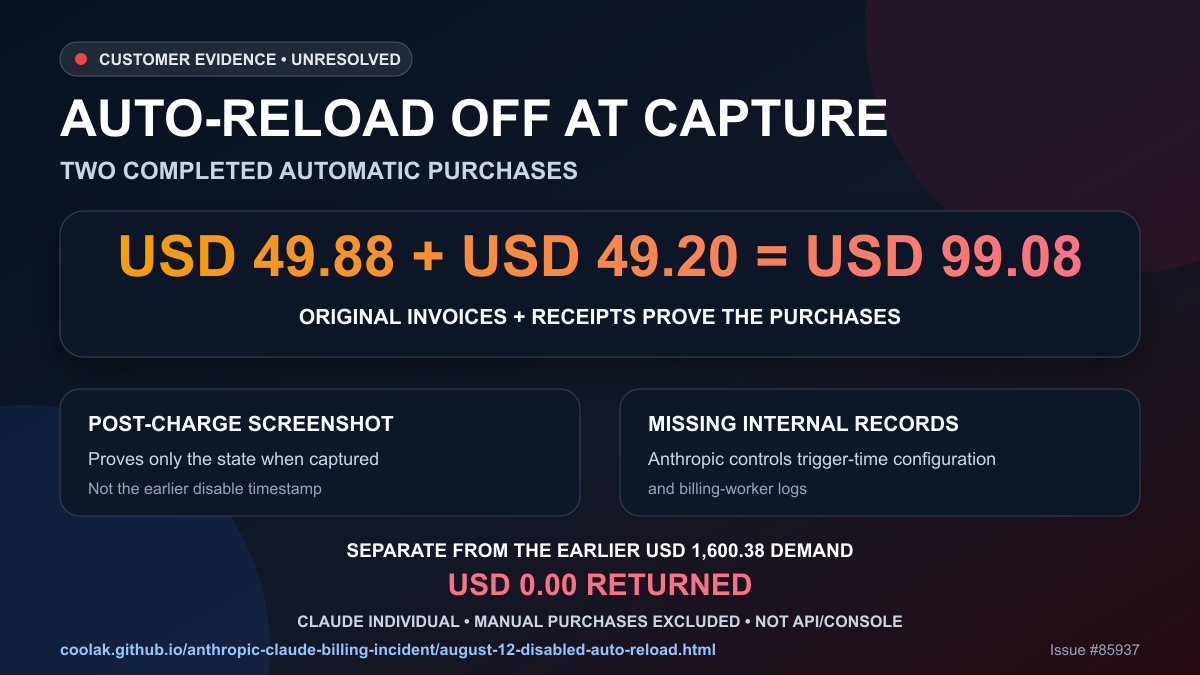
Two original Anthropic invoice/receipt pairs document Claude Individual Auto-recharge credits of USD 49.88 and USD 49.20, totaling USD 99.08. The customer states Auto-reload was disabled before both transactions and blocked the funding card after the second charge.
Open the privacy-safe ten-transaction JSON ledger →
This page uses only track august12_post_charge_capture: two automatic rows totaling USD 99.08. The post-charge capture does not independently prove the historical Auto-reload state at either internal recharge-trigger time. The July 17 and August 1 tracks are separate, and manual purchases remain excluded.
| Receipt email delivered (JST) | Amount | Merchant line item |
|---|---|---|
| 2026-08-12 05:13:57 | USD 49.88 | Auto-recharge credits |
| 2026-08-12 05:56:55 | USD 49.20 | Auto-recharge credits |
| Total | USD 99.08 | Two completed automatic purchases |
The private originals establish the two completed automatic credit-purchase objects, amounts, stated line items, and payment method. They are not manual top-ups and are not Anthropic Console or API-workspace invoices. Invoice, receipt, card, account, contact, address, and support identifiers are intentionally omitted from this public record.
Read-only customer-visible Stripe hosted-invoice records independently map each merchant document pair to a distinct successful payment chain:
| Amount | Payment object created (JST) | Invoice-payment state |
|---|---|---|
| USD 49.88 | 2026-08-12 05:12:29 | Paid at 05:12:32 |
| USD 49.20 | 2026-08-12 05:55:28 | Paid at 05:55:30 |
Both chains use the same card-type Stripe payment-method object. The private Stripe invoice, PaymentIntent, invoice-payment, and payment-method identifiers are withheld publicly but have been supplied in the existing Anthropic, Link, and Stripe complaint threads.
Evidence boundary: these records prove two successful paid processor chains and provide transaction-level correlation. They do not prove the Auto-reload setting at either trigger, explain why Anthropic created the purchases, or establish whether the charges were correct. Anthropic controls the historical configuration, queue, threshold, trigger, and merchant-side refund records.
The capture was taken at 2026-08-12 06:20 JST, approximately 24 minutes after the second receipt email arrived. The visible Turn on button establishes that the customer-facing Auto-reload control was off when the screenshot was captured.
Evidence boundary: this post-charge screenshot does not independently prove the earlier disable timestamp or the setting state at each internal recharge trigger. Anthropic controls the historical setting-change, configuration-version, queue, threshold-evaluation, authorization, capture, retry, and refund logs required to establish that sequence.
An authenticated Claude email was delivered on 2026-07-27 16:00:22 UTC (2026-07-28 01:00:22 JST), fifteen days before the two August 12 receipt emails. Its first-party sender domain passed DKIM, SPF, and DMARC. Its exact Subject header is:
“We turned off auto-reload on your Claude Code account”
The body does not repeat or confirm that setting-change statement. Instead, it describes Anthropic's July 17 billing correction and the USD 3.11 account credit. That subject/body mismatch matters: the Subject header is first-party, pre-charge evidence consistent with the customer's account, but the message is not conclusive proof of a successful user-requested disable action or that the disabled state persisted through either August 12 internal trigger.
A Gmail search covering July 26 through August 12 found no later Anthropic email stating that Claude Auto-reload had been enabled. That absence is not proof that no re-enable event occurred, because Anthropic's notification behavior is not established. Anthropic must reconcile the authenticated message header with its authoritative setting-change and billing-worker logs.
Anthropic's current paid-plan usage-credit guide describes usage credits as part of paid Claude plans, says Auto-reload can be enabled to make an automatic purchase when the balance falls below a customer-set threshold, lists Auto-reload settings as a spending control, and says usage credits apply to Claude Code.
The same guide separately says that disabling usage credits restricts the account to included-plan usage, that included limits continue to reset every five hours, and that paid credits do not change that reset timing. It also says the dashboard distinguishes included-plan use from paid-credit use and that a notification and confirmation precede the switch to paid credits.
Auto-reload and usage-credit access are therefore distinct controls in Anthropic's own model: Auto-reload governs automatic funding of the credit balance, while usage-credit access governs whether an available paid balance may be consumed. This record alleges that Auto-reload was off; it does not allege that the separate usage-credit-access control was off.
That first-party guide establishes the intended customer control model and the paid-plan classification. It does not prove this account's historical toggle state or disclose whether already queued work survives a switch-off. Those facts still require Anthropic's timestamped configuration and trigger records.
A live read of Anthropic's official Statuspage incident API at 2026-08-13 02:00 JST found one incident created from August 9 through August 12 UTC. That incident, Degraded performance for multiple models, began at 2026-08-12 13:50:28 UTC (22:50:28 JST), almost seventeen hours after the second disputed payment was recorded paid at 05:55:30 JST. Its public updates describe elevated request errors across models, primarily Fable 5, and identify claude.ai, the API, Claude Code, and Cowork as affected components. They do not describe billing, payments, invoices, refunds, Auto-reload, usage credits, spend limits, or entitlements.
This means the official public status history does not currently acknowledge an incident that maps to the two early-morning automatic purchases. It does not prove that no account-level billing or configuration failure occurred: a public status page need not list every account-specific or unrecognized failure. Anthropic's timestamped account configuration, session, trigger, purchase, and refund records remain necessary.
This later disabled-Auto-reload incident is separate from the existing July 17 and August 1 entitlement/routing disputes. It does not change the earlier automatic-only original demand of USD 1,600.38. The later demand is exactly USD 99.08. The original arithmetic exposure across the separate tracks is USD 1,699.46, but that figure is not presented as one merged case demand. Anthropic later returned USD 15.26 on one August 1 charge, leaving USD 1,585.12 unresolved on the existing track and the full USD 99.08 unresolved on this standalone track: USD 1,684.20 remaining only as arithmetic across the two separate tracks.
The customer blocked the funding card after the second charge to prevent further automatic withdrawals. That protective action is not an allegation of stolen credentials and is not a chargeback.
On August 15, authenticated Link Support confirmed that its personal-data investigation and written support case remained open. The initial purchase list shown by Link included both disputed August 12 payments, establishing that the two entries were visible to Link's authenticated support team. It did not provide a distinct later-incident reference, a refund or reversal, a transaction-by-transaction disposition, or the historical Auto-reload and recharge-trigger records.
That initial list omitted all eight automatic purchases in the separate USD 1,600.38 July 17/August 1 track and also included unrelated purchases outside both demands. One same-thread written correction reconciled the ten disputed automatic payments, expressly preserved the two separate demands, excluded the unrelated purchases, and asked Link for case linkage, safe processor references, per-transaction status, preservation, merchant-referral, and the next written update.
Link then replied that purchase refunds and invoices are best handled by Anthropic and suggested contacting a bank if the merchant remains unresponsive, while saying that the written support case would remain open. One concise same-thread response acknowledged that routing position, recorded that no original-payment refund had been verified on this standalone track, and asked Link to continue the already-open personal-data and preservation investigation and answer the pending Link-controlled case-status, mapping, merchant-referral, and next-update questions. The two case references in Link's subject both pre-date this August 12 incident; their presence does not establish a distinct later-incident reference. A signed chargeback request covering all ten documented automatic charges was sent to the card-issuing bank on August 20, 2026. On August 21, the bank confirmed that the letter was registered and forwarded to the responsible staff. Formal chargeback acceptance, a merits decision, and any routing to Mastercard remain unconfirmed and pending bank review.
This is verified support-routing and wallet-visibility status only. It is not a Link or Stripe merits finding, an Anthropic response, a transaction-level causation finding, or an original-payment refund. Private account-origin, identity, case, invoice, receipt, card, and unrelated-purchase details remain withheld.
On August 12, one standalone FTC ReportFraud filing for this USD 99.08 incident was accepted and entered Consumer Sentinel. The filing preserves the same proof boundaries and does not merge this demand with the separate USD 1,600.38 track.
This is verified intake status only: it is not an FTC finding, investigation confirmation, or individual-refund decision. The report number and private submission record are withheld from this public page.
On the same date, one application covering only this separate USD 99.08 event was sent through Japan's official Specified Commercial Transactions Act Article 60 procedure to the Consumer Affairs Agency. The submission preserved the screenshot and causal-proof limitations and did not resend or enlarge the earlier USD 1,600.38 demand.
This is filing status only, not an agency finding, investigation result, individual-refund decision, or confirmation of a legal violation.
On August 12, Future Stack Reviews added a dated update to its document-first July 17 usage-credit report. The update cites Anthropic-owned tracker issue #85937 as one visible public report, records the two reported transaction amounts, and notes the signed-in screenshot taken after the charges.
The independent article keeps the same proof boundary as this page: Future Stack Reviews did not reproduce or verify the August 12 event, holds no record of this account, takes no position on whether the charges were correct, and states that the post-charge screenshot does not establish the setting state when either purchase was triggered. It identifies Anthropic's historical records as necessary to settle that point.
Future Stack Reviews did not identify the account holder, connect the private email identity to a public handle or page, or disclose that it had been contacted. This is a verified independent editorial citation, not an Anthropic response, adjudication, aggregate-loss finding, or refund confirmation.
The screenshot, both original invoices, and both original receipts have been delivered privately to Anthropic and through Stripe's formal complaint route. The same five exhibits were supplied to California DFPI as later, separately quantified conduct under an existing evidence channel. The existing human Link complaint thread received one later-conduct routing supplement requesting a distinct reference; no distinct later-incident reference or refund is verified. One standalone FTC ReportFraud filing was accepted into Consumer Sentinel, and one Japanese Article 60 application covering only the separate USD 99.08 event was sent to the Consumer Affairs Agency; both are intake or filing status only, not agency findings or refund decisions, and private identifiers are withheld publicly.
Prior public tracker reports include an earlier disabled-Auto-reload charge report, an extra-usage re-enable and spend-limit report, the open consumer auto-recharge-loop and human-escalation report, and the closed API/prepaid-credit reports #29108 and #53292. Those are separate users' reports. They do not prove this account's historical setting state, transactions, a shared root cause, or aggregate loss. Issues #29108 and #53292 concern credit consumption after an API-key/session event, not completed Claude Individual automatic purchase objects. Issue #68773 is broader than the narrower disabled-control and completed-purchase sequence documented here.
A separate May 8 r/Anthropic user report describes an unexpected additional charge after a manual credit purchase and an Auto-reload control that the reporter said would not switch off; several commenters reported the same control problem. This is anecdotal community reporting about a different account and transaction sequence. It does not prove that this account's control was historically disabled, that the two USD 99.08 purchases share a cause with that report, or that any loss should be aggregated.
A July 20 r/ClaudeAI discussion contains conflicting anecdotal outcomes for Auto-reload-off accounts. One commenter said a Fable task continued after the available credits were exhausted and generated a USD 40 charge even though Auto-reload was off. Another commenter said they repeatedly reached included-plan limits with Auto-reload off and had never received an unexpected extra charge. Neither account supplies original transaction documents or Anthropic's trigger-time records. The contradictory reports do not prove this account's state, a common mechanism, or any aggregate loss; they reinforce why the customer-facing control and the server-side configuration, in-flight-task, trigger, and purchase logs must be reconciled rather than inferred.
A current r/claude report concerning August 9-10 transactions alleges that Extra Usage re-enabled itself twice and that a customer-set spend cap reverted to USD 20,000 after the reporter turned Extra Usage off and reset the cap. The post shows a list of paid transactions and describes multiple charges; several commenters describe other unexpected re-enablement or charge experiences, while other commenters raise account or session compromise as an alternative explanation. The post does not supply original merchant or processor records, historical configuration logs, or Anthropic's trigger records. It is a separate user's anecdotal report, not proof of this account's state, a shared cause, aggregate loss, or refund entitlement. It strengthens the case for immutable, timestamped configuration, session, trigger, and purchase logs rather than inference from the current UI alone.
The reporter later added that Anthropic investigated and refunded the disputed set. A linked public refund-status image visibly shows six rows marked Refunded (EUR 37.48, EUR 40.17, EUR 32.87, EUR 30.89, EUR 30.88, and EUR 60.59) plus one EUR 100 row marked Partially Refunded. That is useful evidence that Anthropic applied merchant-side refund status to transactions in another reported Extra Usage case after investigation. It is not complete proof of the reporter's “entire thing” description: the image does not show the partial-refund amount, does not display the original EUR 148.09 paid row or EUR 90 overdue row, and is not a bank or card statement proving receipt at the original payment method. This later outcome does not verify this account's setting history, trigger path, shared root cause, or refund entitlement. This standalone August 12 track has USD 0.00 refunded; a separate USD 15.26 original-payment refund is mapped only to one August 1 charge.
A fresh separate r/claude report says Usage Credits were off and alleges that 17 individual charges nevertheless appeared, typically in the EUR 40–50 range. The post reproduces text attributed to Fin saying that a pre-request limit check followed by final token accounting might explain minor overage, but not that repeated-charge pattern, and that a human account-level billing investigation was needed. The same post also reproduces an earlier no-compensation statement. This is the reporter's public account, not an authenticated support transcript, original merchant record, processor record, or proof that any refund was refused by a human reviewer.
Control boundary: Usage Credits and Auto-reload are different controls in Anthropic's documented model. The separate report does not establish which control state existed at any trigger, prove this account's historical Auto-reload state, show a shared root cause, verify the reported charge count or amounts, establish aggregate loss, or create refund entitlement here. It is relevant only as a fresh public example in which Fin's reported response itself distinguishes minor overage from a repeated-charge sequence and calls for the same human transaction-level investigation requested in this record.